Prosperity frame
Make the dimensions of value explicit.
Name what matters across self, community, nature, design, and capital before choices are optimized.
RPM gives Wellzai a normative frame for deciding what kind of future a formation should advance. It keeps economic performance, community vitality, natural systems, design quality, and capital from being optimized in isolation.
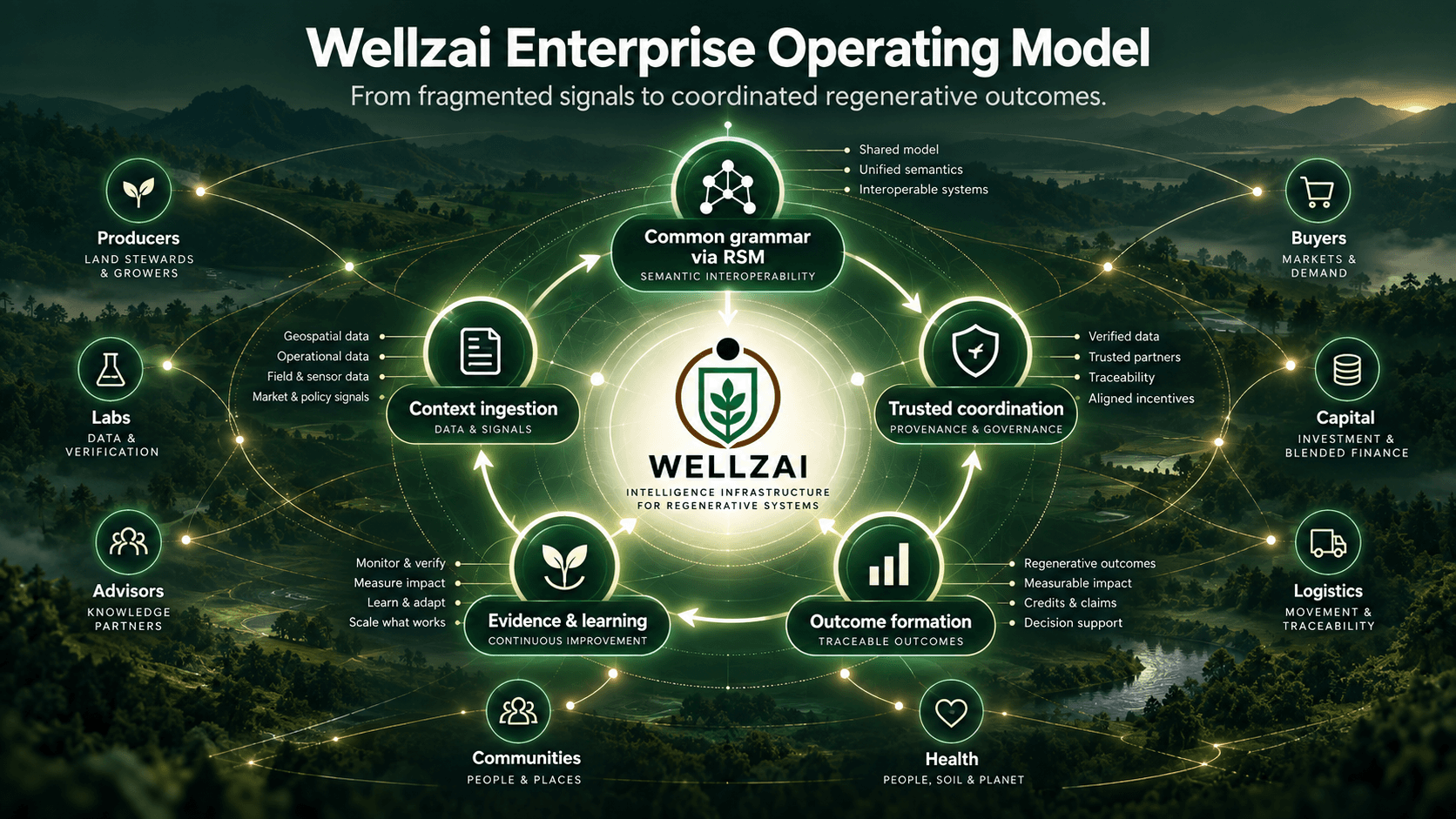
Orientation before optimization
Regenerative work breaks down when every participant carries a different definition of success. RPM creates a shared orientation so a pathway can be evaluated against the health of the larger system rather than a single metric.
Prosperity frame
Name what matters across self, community, nature, design, and capital before choices are optimized.
Tradeoffs
Surface tensions early enough to redesign a pathway instead of discovering downstream harm after execution.
Shared orientation
Align operators, partners, buyers, and capital around what the formation is actually trying to improve.
RPM in a formation
In the Formation Lab, three candidate paths for a 5,000-acre transition are judged against the same frame: grower economics protected, demand committed, claims that hold up. The fastest path fails it.
Where it becomes useful